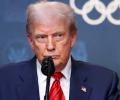
US President Donald Trump reiterated his claim that he "settled" the conflict between India and Pakistan, suggesting it averted a potential nuclear war. He also claimed that several planes were shot down during the conflict.
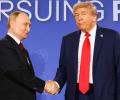
'No respite from economic pain is worth the loss of dignity and self-respect,' asserts former foreign secretary Shyam Saran.

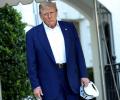
United States President Donald Trump has expressed strong disapproval of Israel and Iran 'violating the ceasefire' he announced earlier in the day and said the two countries have been fighting 'so long and so hard that they don't know what the f*** they're doing'.
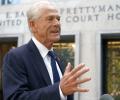
Former White House trade advisor Peter Navarro has criticised India for continuing to procure Russian oil, alleging profiteering and contributing to the Russia-Ukraine war. India defends its energy procurement as driven by national interest and market dynamics.
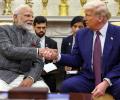
Trump went on to say that "I'm using trade to settle scores and to make peace."
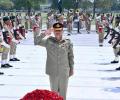
Sections in the US State Department and Pentagon have always felt more comfortable dealing with all powerful Pakistani generals instead of elected civilians, points out Rana Banerji, who headed the Pakistan desk at RA&W.

Gokhale has said that China used its "close connections" with the Left parties in India to "build domestic opposition" to the Indo-US nuclear deal.

Many were hoping that with Vajpayee's NDA gone, there would be a return to the Congress normal. Nobody was prepared for the opposite. Sonia Gandhi was sceptical. This became the only issue over which Manmohan Singh took on his party bosses and risked his government. Politically, it was riskier than the 1991 reform, recalls Shekhar Gupta.
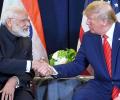
It would be the prime minister's first bilateral visit to the US after Trump became president for a second term.
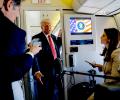
Two 'very smart' leaders of India and Pakistan decided to end last month's conflict that could have turned into a nuclear war, United States President Donald Trump said after holding a rare luncheon meeting with Pakistan army chief Field Marshal Asim Munir at the White House.

External Affairs Minister S Jaishankar discusses India's approach to cross-border terrorism following the Pahalgam attack, emphasizing a firm response and no compromise on nuclear blackmail.
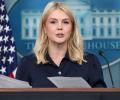
A White House official claims Donald Trump ended several conflicts, including the one between India and Pakistan, and deserves the Nobel Peace Prize. This claim is disputed by India.
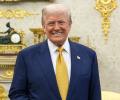
Trump, who has repeatedly said that he stopped the conflict between India and Pakistan through trade, last Friday said for the first time that "five jets were shot down" during the fighting.

Putin is keen on establishing a good personal rapport with Trump and anchor a meaningful US-Russia partnership, realistic enough to accept that Trump is as good an American president as Russia would ever get, observes Ambassador M K Bhadrakumar.

'Pakistan has found itself in a favourable position after Operation Sindoor by appreciating the mediation as claimed by Trump and recommending him for the Nobel Peace Prize.'

Jaishankar said that the Pahalgam attack "was an act of economic warfare. It was meant to destroy tourism in Kashmir, which was the mainstay of the economy. It was also meant to provoke religious violence because people were asked to identify their faith before they were killed."

'Geopolitically and diplomatically it's a very difficult situation for India.'

'It is typical of China's strategic deception of making virtue out of necessity,' observes Rup Narayan Das.

US President Donald Trump has repeated his claim that Washington got involved with India and Pakistan, saying he didn't like what was happening and that he did a good job as he convinced the two countries to let's have peace and let's go and make trade deals.

Trump's new rules for how countries should treat him have led to the current breakdown in India-US relations, explains Ambassador T P Sreenivasan.

A US official has stated that India's continued purchase of Russian oil is a point of contention in the relationship between the two countries, as it helps fund Russia's war efforts in Ukraine.
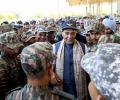
'Pakistan is no longer a front-burner issue for America.'
'We value our friendship with the Left, but not at the cost of the national interest. If this government goes, let it go'
Can the nuclear deal become an election issue? Unfortunately not.
'India should not succumb to the US ploy and help their approach by over-dramatizing the importance of the 123 Agreement to the Indian public.'

Mrs Gandhi's power ebbed and peaked with the times. Mr Modi's has almost been constant, barring the few months of hard dip after the 240 seats of 2024, points out Shekhar Gupta.

Trump has a major decision to take in coming days -- specifically, how to rescue Israel from the attritional war that lies ahead, points out Ambassador M K Bhadrakumar.
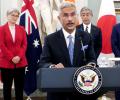
If the only superpower, which calls India an ally, sees the region through an India-Pakistan prism, it is unacceptable. Rather than endorse India's sphere of influence, this undermines it, asserts Shekhar Gupta.
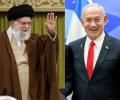
At the end of the day, for many worldwide, the ongoing mutual attacks between Israel and Iran would seem a contest devoid of any moral high ground and only a bout between two ordinary adversaries, one that nevertheless risks spinning out of control into a larger conflagration, notes Shyam G Menon.
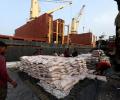
India has a comparative edge over key competitors in a majority of products it exports to the US and stands to gain market share as the US raises tariffs on its major trade partners, NITI Aayog said on Monday. In its quarterly trade report, it recommended that the government fast-track the India-US free trade agreement with time-bound goals to resolve non-tariff barriers and finalise digital trade rules on data flows and e-signatures to support services exports.
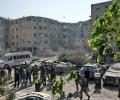
As per Israeli media, at least four people have been killed and several injured after an Iranian missile struck a residential building in Beersheba.
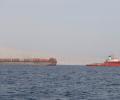
US strikes on Iran's three main nuclear facilities have once again raised concerns that Tehran might shut down the Strait of Hormuz - one of the world's most critical chokepoints, through which a fifth of global oil and gas supply flows.

'We should watch -- in the near term -- for signs that the two have totally fallen out at a personal, political level.' 'Trump and Modi know how to be dealmakers, but they also know how to hold a grudge.'

The United States action of levying 25 per cent additional tariff on Indian goods is 'unfair, unjustified and unreasonable', India said on Wednesday in a firm reaction, signalling increasing tensions between the two strategic partners over New Delhi's energy ties with Moscow.
He then went on to say that, however, he won't get a Nobel Peace Prize for any of his efforts.

External Affairs Minister S Jaishankar addresses Parliament on Operation Sindoor, denying any US trade linkage and highlighting Pakistan's request for a ceasefire through the DGMO channel.

Trump has played throughout his career as a deal-maker who could deliver where others could not, and Ukraine represents the ultimate test of that image, notes Manish Dabhade.
